Colonial Heritage Tourism in Santo Domingo
My MA thesis analyzed the neoliberal tourist industry to understand Spanish colonial influence on Dominican national identity and its relationship to 20th century US imperial projects on the island.
Through five weeks of fieldwork, I examined the tourist landscape of the Dominican Republic’s capital city, Santo Domingo. I paid particular attention to Zona Colonial, a heavily memorialized tourist neighborhood in the city representing the nation’s colonial history.
I analyzed the neighborhood’s colonial architecture in relation to racial production and emphasized the landscape promotes a national identity based on European heritage. I conducted a visual analysis of the city, using photographs I took myself and archival photographs from the Archivo General de la Nación in Santo Domingo. I read the built environment as a public archive through studying monuments, street names, and memorials in Zona Colonial, attending to structures created through Spanish colonial and US imperial influence. My work highlights how colonial heritage tourism and architectural structures are instrumental in shaping collective memory around whiteness.
Through my archival work, I analyzed the contributions of US military occupation in Santo Domingo in promoting a Dominican national identity on anti-blackness, through their dissemination of anti-Haitian ideology. I develop this analysis of anti-Blackness and US imperialism on the island in my dissertation work.
My project was funded by the John L. Warfield Center of African and African American Studies, and I have published a methodological article on critical archive studies based on my research linked here published in Emotion, Space, and Society. For this MA Thesis, I was awarded UT's Outstanding Master's Thesis Award.
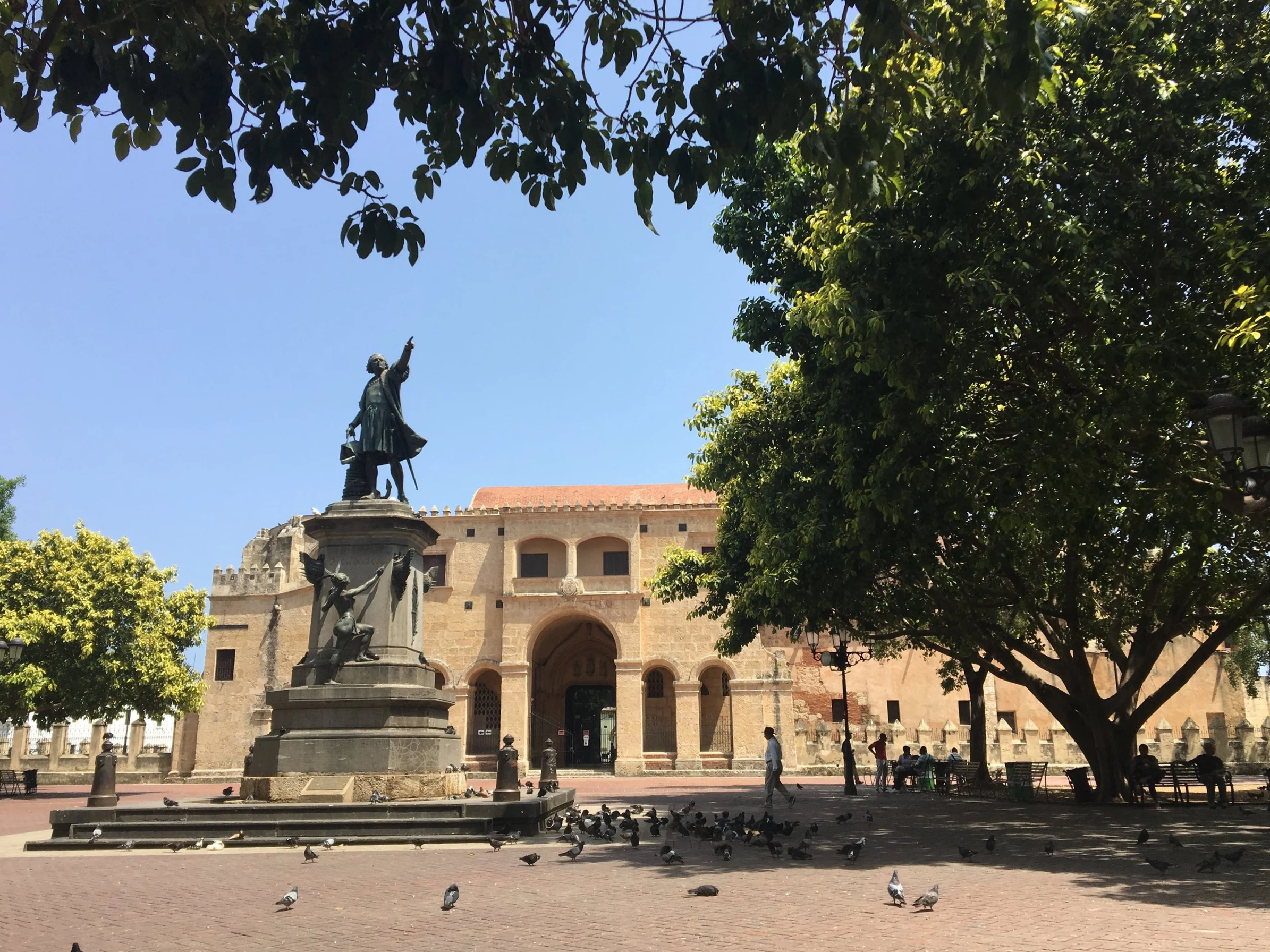
2019 . Santo Domingo, Dominican Republic.
[Image Description: Photo of a statue of Christopher Columbus in Parque Colón. End Description]